
Working capital loan terms are the length, repayment schedule, price and fees attached to short-term business funding. They decide how much you actually pay and how hard the payments hit your cash flow.
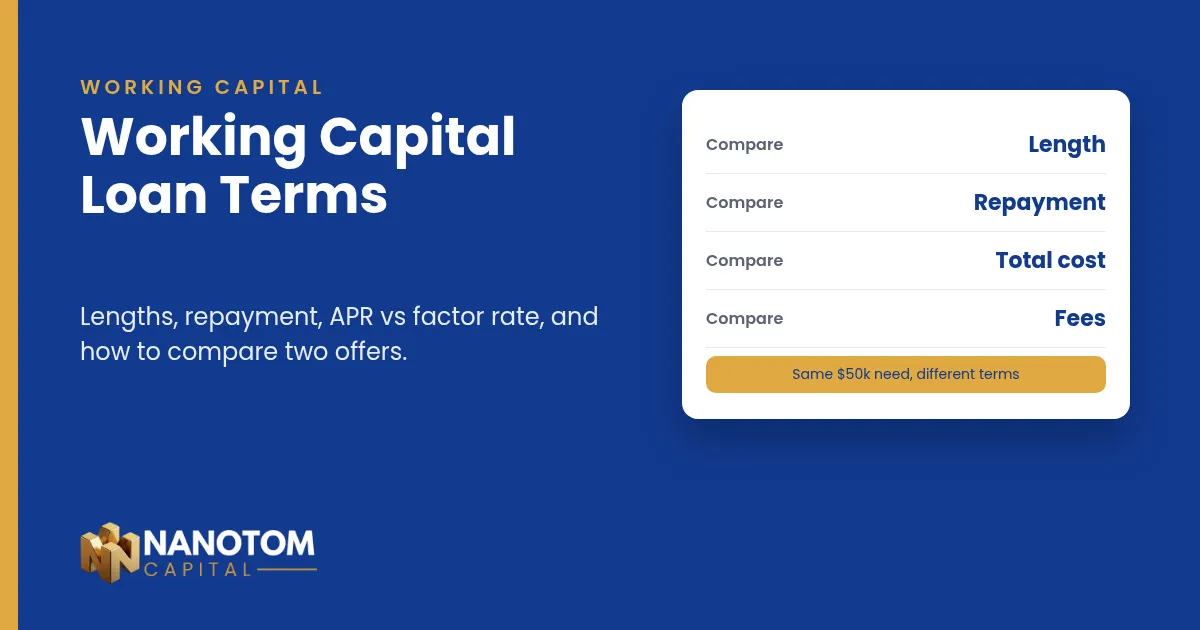
As a business funding broker, we read term sheets next to each other for a living. Two offers for the same $50,000 can look similar on the headline rate and still cost thousands of dollars apart once you line up the term, the payment frequency and every fee. This guide shows what to compare, with a worked example you can copy.
What Working Capital Loan Terms Cover
On a term sheet, "terms" usually means more than the interest rate. Two lenders can quote a similar rate and still give you very different deals once length, fees and payment pace are filled in:
- Amount and term length: how much you receive and how long you have to repay it.
- Repayment schedule: daily, weekly or monthly, and whether the payment is fixed or a share of sales.
- Price: an interest rate shown as an APR, or a factor rate that sets a fixed total repayment.
- Fees: origination, draw, maintenance, renewal, late and prepayment fees.
- Collateral and guarantees: liens on business assets and any personal guarantee.
If you are still sizing the need itself, start with what working capital is. For product options and how to qualify, see our guide to working capital loans for small business.
Typical Lengths by Product Type
Term length should match how long the money stays useful. Inventory that turns in 60 days rarely needs a five-year loan; a multi-year rebuild of working capital can.
| Product type | What the term usually looks like | What to watch |
|---|---|---|
| Short-term online term loan | Often months rather than years; payments may be daily or weekly | Total repayment vs. cash-flow hit from frequent payments |
| Bank or credit-union term loan | Often longer than online products, with monthly payments | Documentation, collateral and time to funding |
| Business line of credit | Revolving; you draw, repay and redraw during the draw period | Draw period vs. repayment period; annual reviews |
| Revenue / merchant advance | Repaid as a share of sales until a fixed total is reached | Factor rate and holdback %, not a stated APR alone |
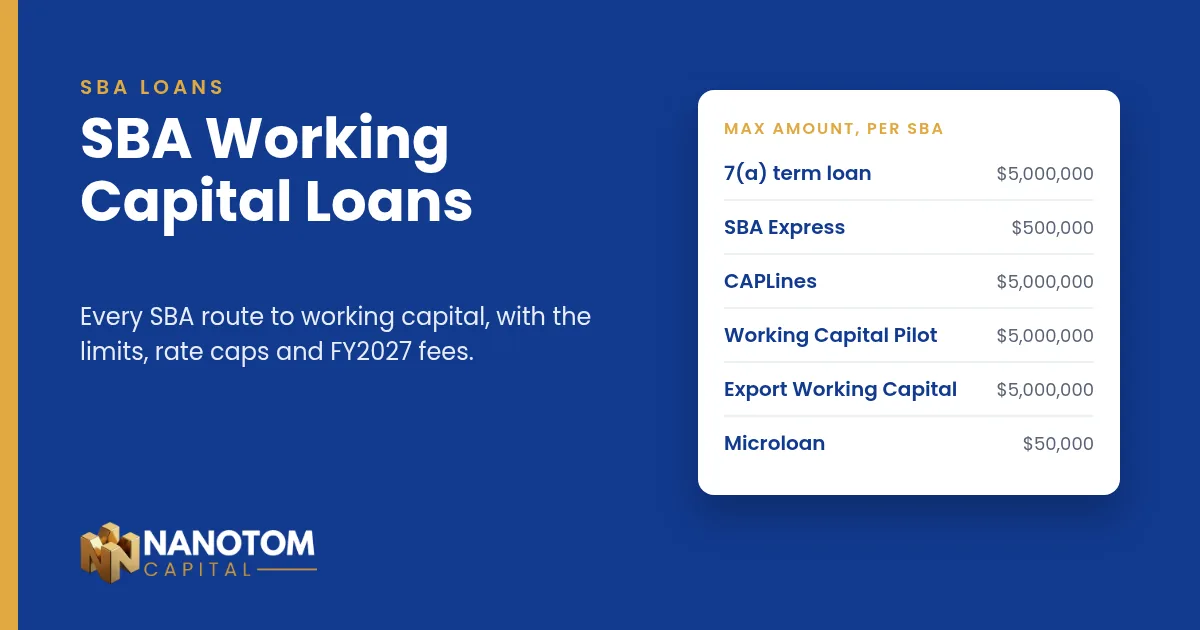
| SBA-backed working capital | SBA rule: shortest appropriate term, generally 10 years or less for working capital (SBA) | More paperwork and a longer path to funding |
Requirements vary by lender. Treat any range you see online as a starting point, then get the term in writing for your own offer. For SBA program limits and fees, see our SBA working capital loans guide.
Repayment Schedules
The same total cost feels very different depending on how often you pay:
- Monthly: common on bank and SBA term loans. Easier to plan around, but each payment is larger.
- Weekly or daily: common on short-term online products and many advances. Smaller each time, but they pull cash constantly.
- Percent of sales: common on revenue-based products. Payments fall when sales fall, and rise when sales rise.
Ask whether the payment is fixed or variable, whether weekends and holidays still pull funds, and what happens on a slow month. A product that looks cheap on total cost can still strain payroll if it drafts every business day.
Also ask when the first payment is due. Some products draft within a day or two of funding; others give a short grace period. That gap matters if the money is already earmarked for a supplier who needs to be paid this week.
How Cost Is Priced: APR vs. Factor Rate
Term loans and lines of credit are usually priced with an interest rate, shown as an APR so you can compare different lengths on equal footing. Revenue advances and similar products are often priced with a factor rate: a fixed total repayment agreed before you sign (for example, 1.30 means you repay $1.30 for every $1 funded).
Do not treat a factor rate as an APR. A 1.30 factor on a three-month advance is a different cost from 1.30 over nine months, even though the factor looks the same. Convert every offer into two numbers you can compare:
- Total dollars you repay (funded amount plus every fee), minus what you actually receive.
- APR, when the product has one, or an estimated annualized cost when it does not, so different terms sit on the same scale.
Some states require many non-bank providers to give you a standardized cost disclosure before you sign. Use it. Requirements vary by state.
Fees to Watch
- Origination or packaging fees taken from the funded amount
- Draw fees on a line of credit
- Maintenance, renewal or unused-line fees
- Late fees and returned-payment fees
- Prepayment or early-payoff charges
- UCC filing or third-party fees passed through to you
Ask for every fee in writing. A lower rate with a large origination fee can cost more than a higher rate with none.
When the fee is taken from the top, confirm the amount that actually lands in your account. A "$50,000" facility with a $1,000 origination fee funds $49,000 unless the fee is paid separately.
Prepayment
Ask one question before you sign: if I pay this off early, how much do I save?
On many interest-bearing term loans, paying early cuts the remaining interest. On many factor-rate advances, the full contracted repayment may still be owed, or a discount may be small. The answer belongs on the term sheet, not in a sales call.
Collateral and Personal Guarantees
Many working capital products take a blanket lien on business assets and ask for a personal guarantee from the owner. Some short-term products lean more on revenue than on hard collateral. Neither is automatically better; both change your risk if something goes wrong.
Read what the lien covers, whether it secures only this facility or other debts with the same lender, and when the guarantee is released.
If more than one owner signs a guarantee, confirm whether liability is joint and several. That detail decides who the lender can pursue if the business cannot pay.
Side-by-Side: Two Hypothetical Offers
Here are two made-up offers for the same $50,000 need. The numbers are for illustration only, not a quote from any lender.
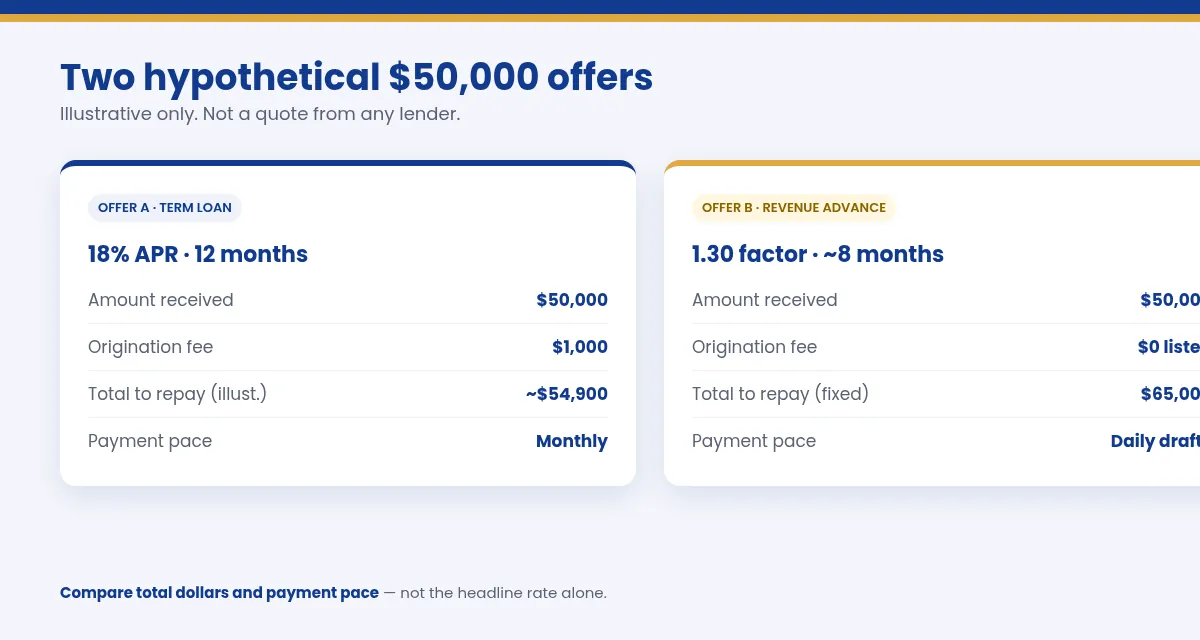
| Offer A: term loan | Offer B: revenue advance | |
|---|---|---|
| Amount received | $50,000 | $50,000 |
| Stated price | 18% APR | 1.30 factor rate |
| Term / payoff | 12 months, monthly | ~8 months at current sales, daily draft |
| Fees | $1,000 origination | $0 listed origination |
| Total to repay | About $54,900 including interest and fee (illustrative) | $65,000 fixed |
| Cash-flow shape | ~12 equal monthly payments | Daily drafts that rise and fall with sales |
Offer A costs less in total on these numbers, but only if you can make the monthly payment. Offer B costs more in total and drafts daily, yet the payment shrinks if sales slow. The "better" term depends on which risk you can live with: a fixed monthly bill, or a higher fixed total with sales-linked drafts.
Run every real offer the same way: total dollars out, payment pace, fees, prepayment and what happens in a slow month.
Which Term Fits Which Need
- One-time gap (inventory buy, tax bill, short project): a term loan sized to that cash cycle.
- Repeating ups and downs: a line of credit you can redraw, so you are not re-applying every time.
- Sales that swing hard week to week: a sales-linked product can flex, but compare the total carefully.
- Longer rebuild with time to document: an SBA-backed option may fit when the term and rate cap matter more than speed.
Match the term to the life of the need, not to the largest amount someone will approve. A larger approval with a payment you cannot make on a quiet month is not a better term.
For current options we place with funding partners, see our working capital financing page. If you track liquidity as a ratio rather than a loan term, see the working capital ratio guide.
Nanotom Capital is a business funding broker; we're not the lender.
Frequently asked questions
What are typical working capital loan terms?
They vary by product and lender. Short-term online loans often run for months with frequent payments; bank loans can run longer with monthly payments; SBA-backed working capital is generally limited to the shortest appropriate term, up to about 10 years. Always get the length, payment schedule and fees in writing.
Is a shorter term always cheaper?
Not always. A shorter term usually means higher payments and can mean a lower total interest cost on an APR-priced loan, but a short factor-rate advance can still be expensive in total. Compare total dollars and payment pace, not term length alone.
What is the difference between APR and a factor rate?
APR is an annualized interest cost used on term loans and many lines of credit. A factor rate sets a fixed total repayment on many revenue advances. A factor rate is not an APR; convert both offers into total dollars (and an annualized view) before you compare them.
Do working capital loans need collateral?
Often yes: a lien on business assets and a personal guarantee are common. Some products lean more on revenue. Requirements vary by lender.
Can I pay off a working capital loan early?
Sometimes. Interest-bearing loans often reduce remaining interest when you prepay. Factor-rate products may still owe most or all of the contracted total. Read the prepayment clause before you sign.
How do I compare two working capital offers?
Line up amount received, total repayment, every fee, payment frequency, term or expected payoff, prepayment rules and collateral. As Denis Brandao, Founder & CEO of Nanotom Capital, puts it: "Your credit score is only part of the story. Revenue and time in business matter just as much."