
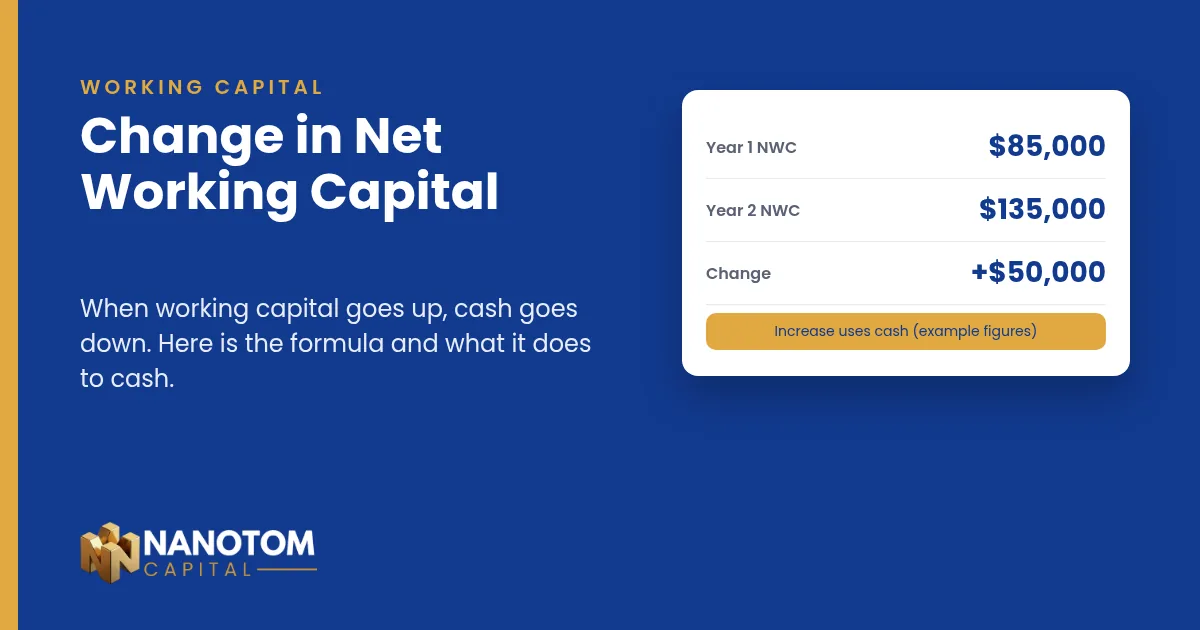
The change in net working capital formula is ending net working capital minus beginning net working capital: how much your working capital grew or shrank between two balance sheet dates. It matters because of one rule: when working capital goes up, cash goes down.
That rule is why a profitable business can feel short of cash: unpaid invoices and inventory hold the difference. As a business funding broker, we help you compare your options when the P&L looks healthy but the bank balance does not. This guide works the formula on one hypothetical business and how to forecast cash before you grow.
What Is Change in Net Working Capital?
Change in net working capital is the difference between your net working capital at the end of a period and at the start. An increase means more cash is tied up in receivables and inventory, which reduces cash from operations. A decrease frees cash.
Working capital, also called net working capital, is current assets minus current liabilities. Our guide to the three ways to calculate net working capital covers the standard, operating, and narrowest versions. For a plain-English refresher, start with what working capital means.
Change in Net Working Capital Formula
Change in NWC = Ending NWC − Beginning NWC
For cash flow and valuation work, use operating net working capital, not the everyday version that still includes cash and short-term debt.
Why this calculation uses operating net working capital
Operating net working capital = (current assets − cash) − (current liabilities − short-term debt)
Cash comes out because cash is the thing you are trying to explain. If it stayed inside the number, the calculation would partly measure itself. Short-term debt comes out because borrowing and repayment are financing decisions, which the cash flow statement reports separately. For the basic dollar calculation, see our guide to calculating working capital step by step.
A note on the sign
This guide uses ending minus beginning: a positive change means working capital grew, so cash was used.
Some financial models flip the subtraction so the sign already matches the cash effect, and a negative number then means working capital grew. WallStreetPrep is one source that presents it that way.
Check which version a report uses before you read the sign. The cash result is the same either way, and the rule never changes: more working capital means less cash.
Change in Net Working Capital Example
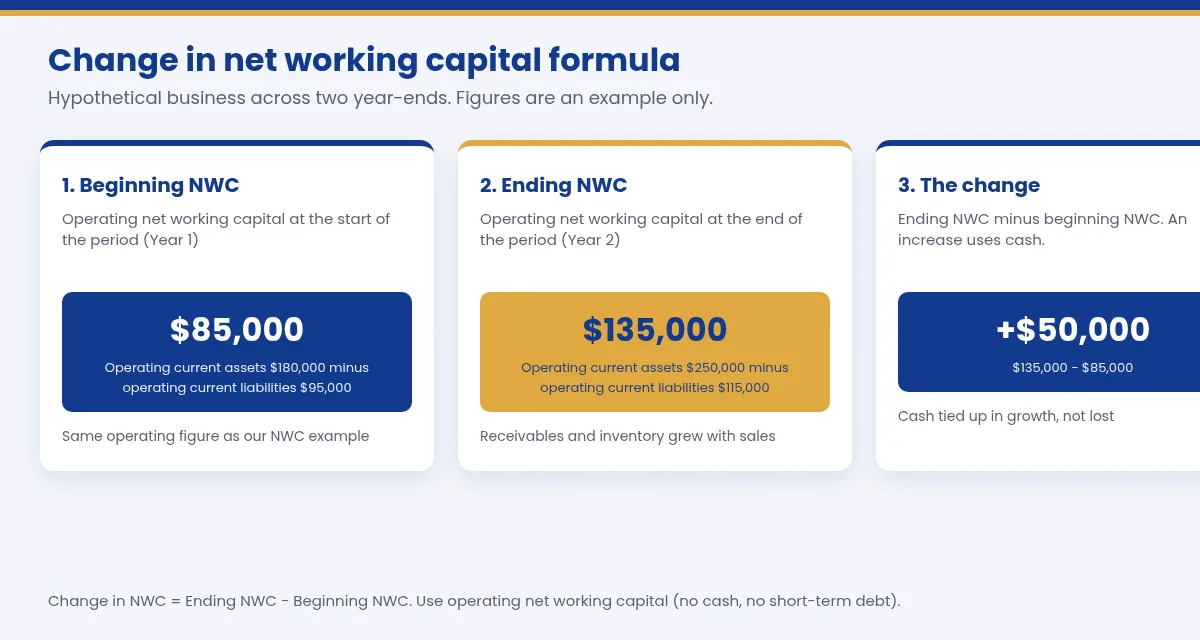
Here is a hypothetical business across two year-ends. The numbers are made up for illustration. Year 1 uses the same operating net working capital figure as our net working capital page, so the two guides tell one story.
| Operating items | Year 1 | Year 2 | Change |
|---|---|---|---|
| Accounts receivable | $90,000 | $130,000 | +$40,000 |
| Inventory | $80,000 | $110,000 | +$30,000 |
| Prepaid expenses | $10,000 | $10,000 | $0 |
| Operating current assets | $180,000 | $250,000 | +$70,000 |
| Accounts payable | $70,000 | $85,000 | +$15,000 |
| Accrued payroll and taxes | $25,000 | $30,000 | +$5,000 |
| Operating current liabilities | $95,000 | $115,000 | +$20,000 |
| Operating net working capital | $85,000 | $135,000 | +$50,000 |
Change in NWC = $135,000 − $85,000 = $50,000. The business grew, customers owe it more, and it is carrying more stock. That growth absorbed $50,000 of cash.
How It Shows Up on the Cash Flow Statement
The cash flow statement starts with net income. Then, as the U.S. Securities and Exchange Commission's beginners' guide puts it, it "adjusts net income for any non-cash items (such as adding back depreciation expenses) and adjusts for any cash that was used or provided by other operating assets and liabilities" (SEC).
Using the same hypothetical business, with net income of $60,000 and depreciation of $10,000 (simplified, ignoring taxes and other items):
| Cash flow from operating activities | Amount |
|---|---|
| Net income | $60,000 |
| Add back depreciation | +$10,000 |
| Increase in accounts receivable | −$40,000 |
| Increase in inventory | −$30,000 |
| Increase in accounts payable | +$15,000 |
| Increase in accrued payroll and taxes | +$5,000 |
| Cash from operating activities | $20,000 |
A $60,000 profit became $20,000 of cash. The $50,000 change in working capital is the gap.
Read the signs this way:
- An asset going up uses cash (you have paid for inventory or are still waiting to be paid).
- A liability going up provides cash (you have not paid that bill yet).
Is an Increase in Working Capital Good or Bad?
It depends on why it happened.
- Healthy: sales are growing, so receivables and inventory grow with them. That is normal, but it still needs cash, and fast growth can strain it.
- A warning sign: sales are flat but receivables keep climbing (customers paying slower) or inventory piles up (stock is not selling).
- A decrease frees cash. That is useful if you collected faster or trimmed slow stock. It is less helpful if you stretched suppliers until they started pushing back.
Using It to Forecast Cash Needs
Change in working capital is most useful before growth, not after. NYU Stern professor Aswath Damodaran notes that "changes in non-cash working capital are unstable" year to year, and suggests tying forecasts to expected changes in revenue instead (NYU Stern).
A simple version:
- Divide operating net working capital by annual revenue. If our hypothetical business had $900,000 in Year 2 revenue, that is $135,000 ÷ $900,000 = 15%.
- Multiply that percentage by your expected revenue growth. Growing by $200,000 would tie up about $30,000 more.
- Plan for that cash before the growth arrives, not after.
If your business is seasonal, do the same exercise month by month. A retailer stocking up for the holidays can see working capital jump for a few months and then fall back. The cash gap is real even if the full year looks fine.
How to Reduce the Cash Tied Up in Working Capital
- Invoice on delivery and follow up on overdue accounts quickly.
- Offer easy payment options, or deposits on large orders.
- Order inventory closer to when you need it.
- Negotiate supplier terms that match how long it takes you to collect.
- Review the numbers monthly so changes do not surprise you at year-end.
When Financing Makes Sense
Financing can bridge the gap when growth is why working capital is rising and the cash will come back as customers pay. Options include a business line of credit, receivables financing and other working capital loans for small businesses.
Some products, such as a merchant cash advance, are priced with a factor rate instead of an APR. Compare the total repayment amount before you choose. See our working capital financing options when the cushion runs thin.
If the increase comes from slow collections or unsold stock, fix the cause first. Financing only papers over it.
Nanotom Capital is a business funding broker; we're not the lender.
Frequently asked questions
How do you calculate change in net working capital?
Subtract beginning net working capital from ending net working capital. For cash flow work, use operating net working capital (no cash, no short-term debt) on both dates.
Should change in net working capital be positive or negative?
Neither is automatically better. Using ending minus beginning, a positive change means cash was tied up and a negative change means cash was freed. What matters is the reason behind it.
Do you add or subtract change in NWC when calculating cash flow?
Subtract an increase and add a decrease. If your template already flips the sign (beginning minus ending), you add the result.
Is change in net working capital the same as free cash flow?
No. It is one input. Free cash flow starts from operating profit or cash from operations, subtracts the increase in working capital, and also subtracts capital spending.
Why is my profit higher than my cash?
Often because working capital grew: sales were booked but not yet collected, or cash went into inventory. Loan principal payments and equipment purchases are other common reasons.
Should I use financing when working capital is rising?
It can make sense when the increase comes from growth and the cash will return as customers pay, and less sense when the cause is slow collections or unsold stock. As Denis Brandao, Founder & CEO of Nanotom Capital, puts it: "Fast money is great until it costs you twice. Know your total cost of capital before you commit."