
Net working capital (NWC) is your current assets minus your current liabilities: what you'll turn into cash within a year, minus what you owe within a year. For most small businesses, it's the same number as what working capital means day to day.
The catch is that analysts, investors and business buyers often use a narrower version that leaves out cash and debt. As a business funding broker, we see owners get confused when a buyer or lender quotes a different NWC number than the one on their own books. This guide shows the three common formulas side by side on one balance sheet, and when each one matters.
What Is Net Working Capital?
Net working capital is the difference between a business's current assets and its current liabilities. A positive number means short-term assets cover short-term obligations.
In everyday use it's the same as working capital. Analysts often calculate it without cash and debt to focus on the money tied up in day-to-day operations, which is why the same balance sheet can produce more than one NWC figure.
The Three Net Working Capital Formulas
Corporate Finance Institute lists three ways to calculate it, from broadest to narrowest (CFI):
| Version | Formula | Who tends to use it |
|---|---|---|
| Standard | Current assets − current liabilities | Owners and bookkeepers, everyday use |
| Operating (non-cash) | (Current assets − cash) − (current liabilities − short-term debt) | Analysts, investors, business buyers |
| Narrowest | Accounts receivable + inventory − accounts payable | Quick operating checks and forecasts |
CFI notes that NWC "is most commonly calculated by excluding cash and debt (current portion only)", in the finance world at least. If you're calculating it for your own records, the standard version is fine. For a full walkthrough of the basic math, see our guide to calculating working capital step by step.
How to Calculate Net Working Capital, Step by Step
- Pull your balance sheet for the date you care about, usually month-end.
- Total your current assets: cash, receivables, inventory, prepaid expenses and anything else you expect to turn into cash within 12 months.
- Total your current liabilities: supplier bills, accrued payroll and taxes, credit card balances and loan payments due within 12 months.
- Subtract liabilities from assets for the standard version.
- For the operating version, remove cash from assets and interest-bearing debt from liabilities, then subtract again.
Your accounting software can usually run a balance sheet for any date, so you can repeat this monthly with the same method.
Net Working Capital Example
Here's a hypothetical business. The numbers are made up for illustration.
| Current assets | Current liabilities | ||
|---|---|---|---|
| Cash | $60,000 | Accounts payable | $70,000 |
| Accounts receivable | $90,000 | Loan payments due within 12 months | $50,000 |
| Inventory | $80,000 | Accrued payroll and taxes | $25,000 |
| Prepaid expenses | $10,000 | Credit card balances | $15,000 |
| Total | $240,000 | Total | $160,000 |
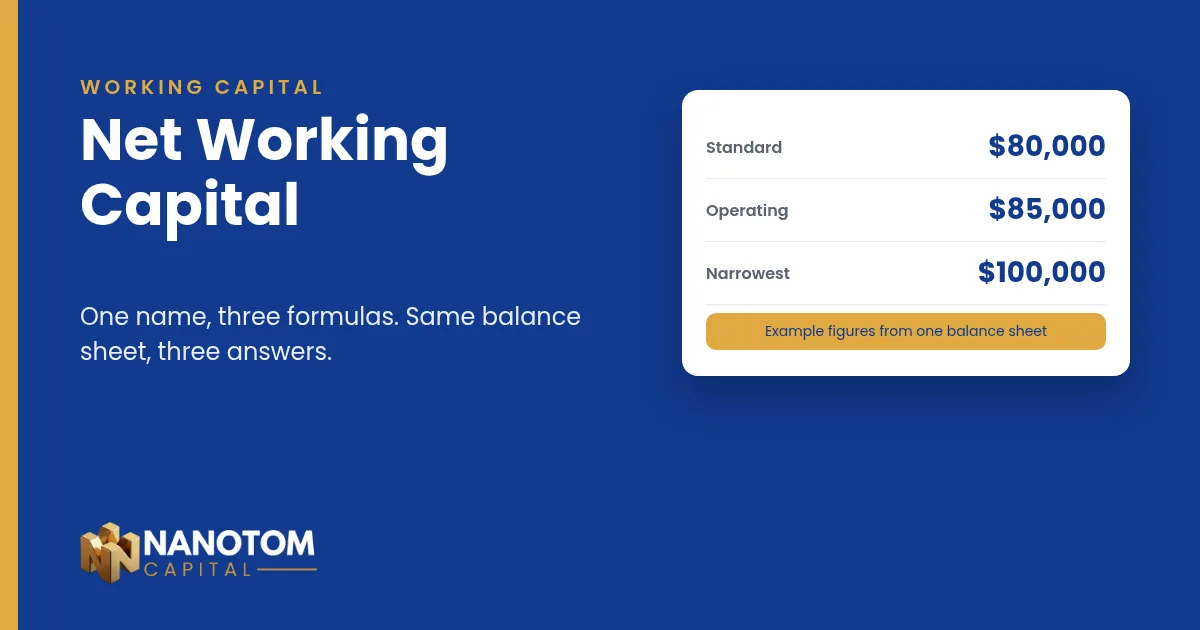
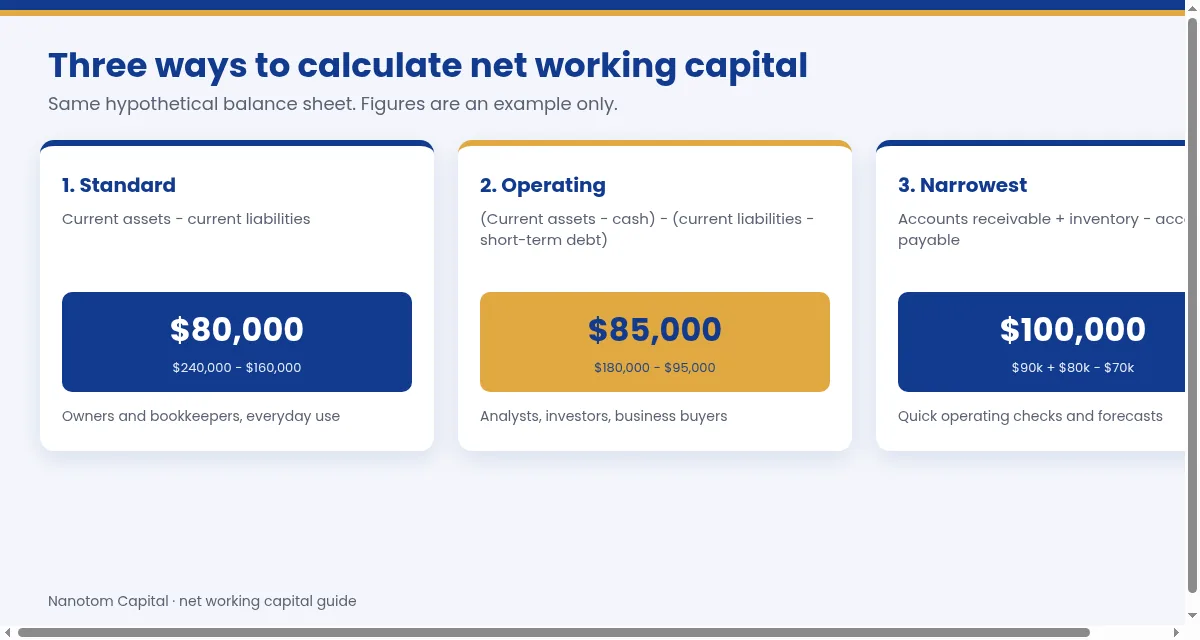
1. Standard: $240,000 − $160,000 = $80,000
2. Operating: Take cash out of assets ($240,000 − $60,000 = $180,000). Take interest-bearing debt out of liabilities: the loan payments and the credit card balances ($160,000 − $50,000 − $15,000 = $95,000). Then $180,000 − $95,000 = $85,000
3. Narrowest: $90,000 receivables + $80,000 inventory − $70,000 payables = $100,000
Same business, three answers. None is wrong. They answer slightly different questions.
Net Working Capital vs. Working Capital vs. Gross Working Capital
| Term | Formula | Example result |
|---|---|---|
| Gross working capital | Total current assets | $240,000 |
| Working capital / net working capital (standard) | Current assets − current liabilities | $80,000 |
| Operating net working capital | Non-cash current assets − non-debt current liabilities | $85,000 |
Gross working capital tells you what you have. Net working capital tells you what's left after what you owe.
Why Analysts Leave Out Cash and Debt
The operating version is meant to measure the cash tied up in running the business: money waiting in receivables, sitting on shelves as inventory, or held back because suppliers haven't been paid yet. That focus helps a buyer or lender see how much capital the operations themselves need, separate from the cash balance and the debt structure.
- Cash is left out because it isn't tied up in operations. It's available, and it can earn a return on its own.
- Interest-bearing debt is left out because it's a financing decision, and valuation models already count it elsewhere.
NYU Stern professor Aswath Damodaran explains this adjustment for valuation, and calls the result "non-cash working capital" (NYU Stern). WallStreetPrep calls it operating working capital (WallStreetPrep). Different names, same idea.
What Positive, Negative and Zero NWC Mean
- Positive: current assets exceed current liabilities. You have a cushion for bills due in the next year.
- Zero: assets and obligations match exactly. There's no room for a slow month.
- Negative: you owe more in the next year than your current assets cover.
Negative isn't always trouble. A business that collects from customers at the time of sale but pays suppliers on 30-day terms can run negative working capital and still pay every bill on time. It becomes a problem when it's negative because customers pay slowly, inventory isn't moving or short-term debt is piling up.
Which Version Should You Use?
- Running the business month to month: the standard version. It's simple, and it matches what most people mean.
- Talking to a lender: start with the standard version. Lenders may also look at your working capital ratio and cash flow. Ask which figures they use.
- Selling the business or bringing in an investor: expect the operating version. In a sale, buyers often agree on a target level of working capital, called a working capital peg, that the seller has to leave in the business.
Whatever version you use, use the same one every time so the numbers are comparable.
How Net Working Capital Connects to Cash Flow
NWC is a snapshot. The more useful question is often how it moves.
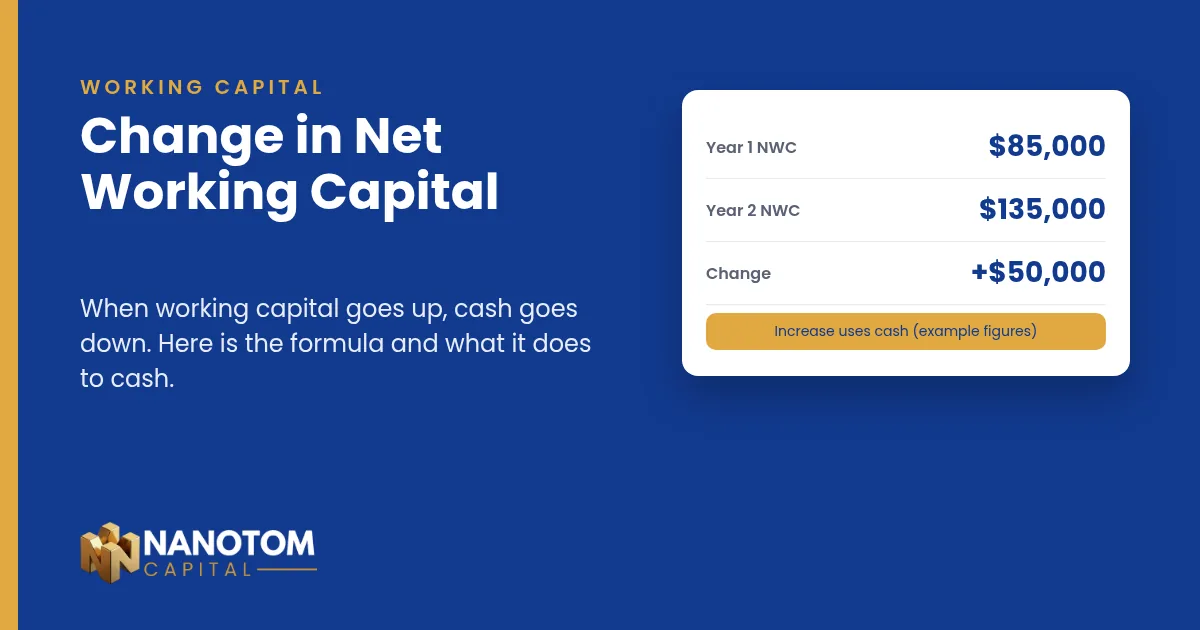
When receivables and inventory grow faster than what you owe suppliers, NWC rises, and that growth is paid for with cash. That's why a growing, profitable business can still feel short of money. Our guide to change in net working capital walks through how to measure it and how it shows up on your cash flow statement.
How to Improve Net Working Capital
Improving NWC usually means freeing cash that is already on the balance sheet, not just borrowing more.
- Collect receivables faster: invoice promptly and follow up on overdue accounts.
- Keep inventory lean: stock that isn't selling ties up cash.
- Use supplier terms fully, without paying late.
- Match financing to the need: long-lived assets on longer-term financing, short-term needs on short-term tools.
If you're watching liquidity as a ratio rather than a dollar amount, see our working capital ratio guide. That metric divides current assets by current liabilities instead of subtracting them.
When Financing Makes Sense
If a healthy business is short of cash because money is tied up in receivables or inventory, financing can bridge the gap while you fix the cause. Options include lines of credit, receivables financing and other working capital loans for small businesses.
Some products, like a merchant cash advance, are priced with a factor rate rather than an APR, so compare the total repayment amount carefully. See our working capital financing options when the cushion runs thin.
Nanotom Capital is a business funding broker; we're not the lender.
Frequently asked questions
Is net working capital the same as working capital?
In everyday use, yes. Both are current assets minus current liabilities. In finance and valuation, "net working capital" often means the operating version that leaves out cash and debt.
Is net working capital a current asset?
No. It's the difference between current assets and current liabilities, not an item on the balance sheet itself.
Can net working capital be negative?
Yes. It means current liabilities exceed current assets. Whether that's a problem depends on why: fast-collecting businesses can run negative NWC safely.
What is a good net working capital ratio?
"Net working capital ratio" usually means current assets divided by current liabilities, the same as the working capital ratio or current ratio. Published guides put a healthy range somewhere between about 1.2 and 2.0, depending on the source, and requirements vary by lender. For the full treatment of that metric, see our working capital ratio guide linked above.
Is higher net working capital always better?
No. Too little can mean trouble paying bills. Too much can mean cash stuck in receivables or inventory that could be working for the business.
Do lenders only look at net working capital?
No. NWC is one liquidity signal among several, and requirements vary by lender. As Denis Brandao, Founder & CEO of Nanotom Capital, puts it: "Your credit score is only part of the story. Revenue and time in business matter just as much."