
Yes, you can get an SBA working capital loan. The U.S. Small Business Administration says its 7(a) loans can fund "short- and long-term working capital," and several 7(a) programs are built for it, including revolving lines of credit.
The SBA doesn't lend the money itself. A bank, credit union or other SBA-participating lender makes the loan, and the SBA backs part of it.
As a business funding broker, we look at SBA loans next to every other way to fund working capital, so this guide puts each SBA route side by side, with the limits, rate caps and fees the SBA publishes. Program figures were checked against sba.gov on October 30, 2026.
Can You Use an SBA Loan for Working Capital?
Yes. SBA 7(a) loans can fund short- and long-term working capital, such as payroll, inventory and day-to-day expenses, as well as other business purposes (SBA). The SBA guarantees part of the loan, and an SBA-participating lender makes it and sets the final terms within SBA rules.
If you're still sizing the need, our guide to working capital explains how to measure it.
SBA Working Capital Programs at a Glance
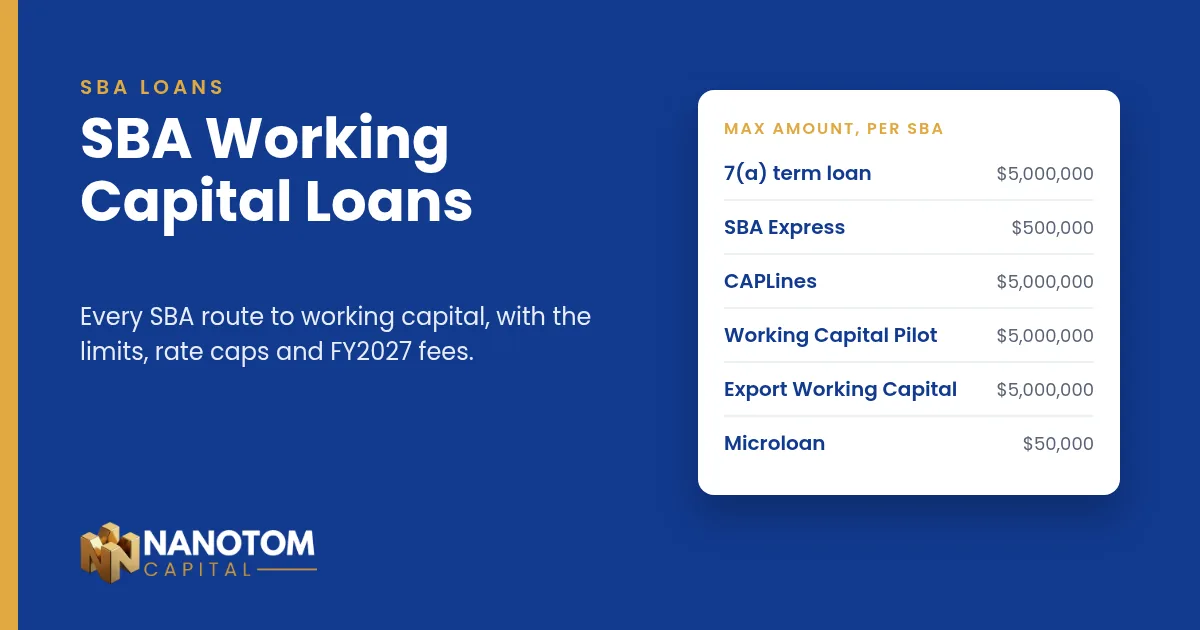
| Program | Max amount | Max SBA guaranty | Revolving? | Max maturity |
|---|---|---|---|---|
| 7(a) term loan | $5,000,000 | 85% up to $150,000; 75% above | No | 10 years for working capital |
| SBA Express | $500,000 | 50% | Yes | Lines up to 10 years |
| CAPLines | $5,000,000 (7(a) max) | 85% / 75% (standard 7(a)) | Yes or no, by type | 10 years (Builders differs) |
| 7(a) Working Capital Pilot | $5,000,000 | 85% up to $150,000; 75% above | Yes, monitored line | 60 months |
| Export Working Capital Program | $5,000,000 | 90% | Yes | 36 months or less |
| Export Express | $500,000 | 90% up to $350,000; 75% above | Yes | Lines up to 7 years |
| Microloan | $50,000 | Not a guaranty (made by nonprofit intermediaries) | No | Set by the intermediary |
Sources: SBA lender resources, SBA Microloans, both checked October 30, 2026. SBA's maximum exposure on any 7(a) loan is $3.75 million.
7(a) Term Loans for Working Capital
A standard 7(a) term loan gives you a lump sum that you repay in monthly installments. For working capital, the SBA's rule is that the term should be "the shortest appropriate term (see our guide to typical lengths and repayment)" given your ability to repay, and 10 years or less unless the loan also finances real estate or long-lived equipment.
Loans of $350,000 or less fall under "7(a) Small" rules. Larger ones are "Standard 7(a)." Under standard 7(a), revolving lines of credit are allowed only through SBA Express, Export Express or CAPLines.
That makes a regular 7(a) term loan the usual fit for a one-time need, such as building inventory for a new contract or replacing working capital you've used up.
For a full comparison of 7(a), 504 and microloans, see our SBA loans guide.
SBA Express Loans and Lines of Credit
SBA Express trades a smaller guaranty for speed. Lenders with Express authority use their own forms and procedures and make the credit decision themselves, without SBA review.
- Up to $500,000
- 50% SBA guaranty
- Revolving lines of credit up to 10 years
- Lenders aren't required to take collateral for loans up to $50,000
Because the lender makes the credit decision and keeps more of the risk, ask each Express lender about its own requirements.
SBA CAPLines
CAPLines is an SBA umbrella program for short-term and cyclical working capital needs. There are four types:
- Seasonal CAPLine: finances seasonal increases in receivables and inventory, and in some cases the extra labor costs that come with them.
- Contract CAPLine: finances the costs of one or more specific contracts, including allocable overhead.
- Builders CAPLine: finances small general contractors building or renovating residential or commercial property for resale.
- Working CAPLine: an asset-based revolving line for businesses that extend credit to other businesses. You borrow against existing receivables and inventory and repay as they turn into cash. The SBA notes that lenders may charge extra fees for the collateral monitoring this requires.
Except for Builders CAPLine, the maximum maturity is 10 years.
The 7(a) Working Capital Pilot (WCP)
The Working Capital Pilot, available since August 1, 2024, offers monitored lines of credit inside the 7(a) program. According to the SBA, it can:
- support asset-based lending against receivables and inventory;
- support transaction-based lending for specific orders or projects;
- finance domestic and export sales under one facility.
| WCP term | SBA rule |
|---|---|
| Maximum line | $5,000,000 |
| SBA guaranty | 85% up to $150,000; 75% above |
| Maturity | Up to 60 months |
| Time in business | 12 full months of operations before applying |
| Reporting | Timely financial statements, receivables and payables agings, and inventory reports |
The main difference is cost structure. Instead of one large upfront fee sized for a long-term loan, the WCP guaranty fee scales with how long the line runs (see the fee section below). SBA also offers one-on-one help from its Finance Managers for WCP deals.
The WCP is a pilot, so its rules can change. Check the SBA's 7(a) pages before you apply.
Export Working Capital
If you sell overseas, two programs cover working capital for export sales:
- Export Working Capital Program (EWCP): up to $5 million, 90% guaranty, terms of 36 months or less. Unlike most SBA loans, the SBA sets no maximum interest rate on EWCP loans. The export inventory and foreign receivables generally serve as collateral.
- Export Express: up to $500,000, with Express-style lender processing and a higher guaranty than regular SBA Express.
SBA Microloans
For smaller needs, SBA microloans go up to $50,000 and can be used for working capital and inventory. The SBA says the average microloan is about $13,000.
Microloans are made by nonprofit intermediary lenders, which set the terms and make the credit decisions. Microloans can't be used to pay existing debts or buy real estate.
Interest Rate Caps
You and the lender negotiate the rate, but it can't exceed the SBA maximum. For variable-rate 7(a) loans, including WCP lines, the caps are:
| Loan amount | Maximum variable rate |
|---|---|
| $50,000 or less | Base rate + 6.5% |
| $50,001 to $250,000 | Base rate + 6.0% |
| $250,001 to $350,000 | Base rate + 4.5% |
| More than $350,000 | Base rate + 3.0% |
The base rate is the prime rate or SBA's optional peg rate. Since March 1, 2026, lenders may also use SOFR or the 5-year or 10-year Treasury rate as a base, but the result still can't exceed prime plus the allowed spread (Federal Register). Fixed-rate maximums are published separately by the SBA.
Hypothetical example: if the base rate were 7.00%, a $100,000 variable-rate loan could carry at most 13.00%, and a $500,000 loan at most 10.00%. The cap is a ceiling, not a quote.
EWCP loans are the exception: there's no SBA maximum rate.
SBA Fees for Fiscal Year 2027
The SBA charges lenders an upfront guaranty fee, which lenders are allowed to pass on to you. For loans approved from October 1, 2026, through September 30, 2027 (SBA Information Notice 5000-881797, published September 3, 2026):
| Loan (maturity over 12 months) | Upfront fee, on the SBA-backed share |
|---|---|
| $150,000 or less | 2% |
| $150,001 to $700,000 | 3% |
| $700,001 to $5,000,000 | 3.5% up to $1,000,000, plus 3.75% above $1,000,000 |
| Any amount, maturity 12 months or less | 0.25% |
Loans of $700,000 or less to manufacturers, certain food-supply-chain businesses and rural businesses have a 0% upfront fee in FY2027.
Working Capital Pilot lines have their own schedule: 0.25% (12 months or less), 0.525% (13 to 24 months), 0.80% (25 to 36 months), 1.075% (37 to 48 months) and 1.35% (49 to 60 months) of the SBA-backed share.
Hypothetical examples using the SBA's published schedule (examples only, not a quote):
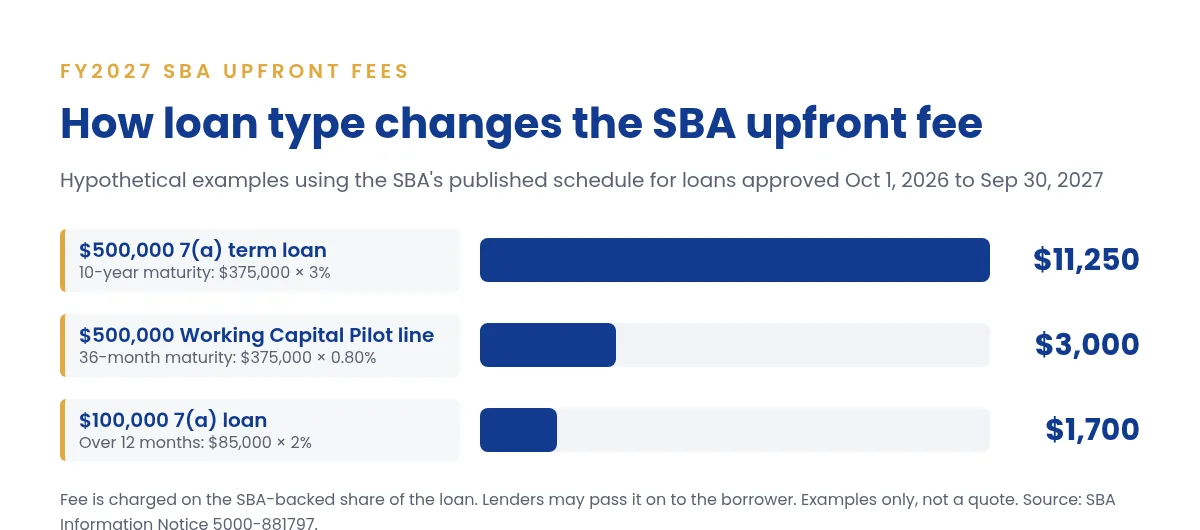
- $500,000 7(a) term loan, 10-year maturity: 75% SBA-backed share ($375,000) × 3% = $11,250 upfront fee.
- $500,000 WCP line, 36-month maturity: $375,000 × 0.80% = $3,000.
- $100,000 7(a) loan, maturity over 12 months: 85% SBA-backed share ($85,000) × 2% = $1,700.
There's also an annual service fee of 0.55% on the SBA-backed balance, but lenders can't charge it to you. Lenders may charge some other fees within SBA rules, so ask for a full fee list in writing.
Who Qualifies
To be eligible for a 7(a) loan, the SBA says a business must:
- be an operating, for-profit business located in the U.S.;
- be small under SBA size standards;
- not be an ineligible business type;
- be unable to get the credit on reasonable terms from non-government sources;
- be creditworthy, with a reasonable ability to repay.
The SBA doesn't publish a single minimum credit score on these program pages. It says lenders "may use a business credit scoring model, credit score, or credit history," and may also consider cash flow, equity or collateral. The Working Capital Pilot adds the 12-month operating history and reporting requirements above.
Our SBA eligibility requirements guide covers the details.
How to Apply
- Decide which program fits: a one-time need (7(a) term), a revolving need (Express, CAPLines, WCP) or export sales (EWCP).
- Prepare your financials: recent financial statements, tax returns, a debt schedule and, for lines of credit, receivables and payables agings.
- Find an SBA-participating lender. The SBA's free Lender Match tool prepares a summary of interested lenders two business days after you submit a request.
- Compare offers: rate (against the cap), every fee, collateral and reporting requirements.
- Watch for agent fees. If anyone, such as a broker, packager or consultant, is paid to help with your SBA application, the lender must disclose it on SBA Form 159. The SBA doesn't allow fees paid only if the loan is approved.
When an SBA Loan Isn't the Right Fit
SBA loans take more documentation and more time than most working capital products. An SBA file takes weeks rather than hours.
The SBA's own lender page lists a 2 to 10 business day turnaround for its review of 7(a) Small loans and 5 to 10 business days for Standard 7(a), and that comes after the lender's own underwriting.
If you need cash this week, or you don't yet have 12 months of history, other working capital financing may fit better. Some, like a merchant cash advance, are priced with a factor rate rather than an interest rate, so compare the total repayment amount carefully.
Nanotom Capital is a business funding broker; we're not the lender, and we're not an SBA lender. The SBA sets eligibility, and SBA-participating lenders make the loans. If an SBA loan looks like a fit, we can connect you with a partner that handles SBA loans. See our SBA loan options.
SBA Working Capital Loan FAQs
Can SBA loans be used for working capital?
Yes. 7(a) loans can fund short- and long-term working capital, and SBA Express, CAPLines, the Working Capital Pilot and the export programs offer lines of credit for it.
Does the SBA offer a line of credit?
Not directly, but SBA-participating lenders offer SBA-backed lines through SBA Express (up to $500,000), CAPLines, Export Express and the 7(a) Working Capital Pilot (up to $5 million).
How much can I get with an SBA working capital loan?
Up to $5 million under 7(a), CAPLines, the WCP or EWCP. SBA Express and Export Express top out at $500,000, and microloans at $50,000. The lender decides how much you qualify for.
What is the interest rate on an SBA working capital loan?
It's negotiated with the lender, up to the SBA cap: for variable-rate loans, the base rate plus 3.0% to 6.5%, depending on loan size. EWCP loans have no SBA cap.
Can I use an SBA loan to cover payroll?
Yes. Payroll is a working capital expense, and 7(a) loans can fund short- and long-term working capital. The lender still decides whether your business qualifies.
What fees come with an SBA working capital loan?
Mainly the SBA upfront guaranty fee, which the lender may pass on to you. In FY2027 it ranges from 0.25% of the SBA-backed share for loans of 12 months or less up to 3.75% on the largest long-term loans, with a separate, lower schedule for Working Capital Pilot lines.