
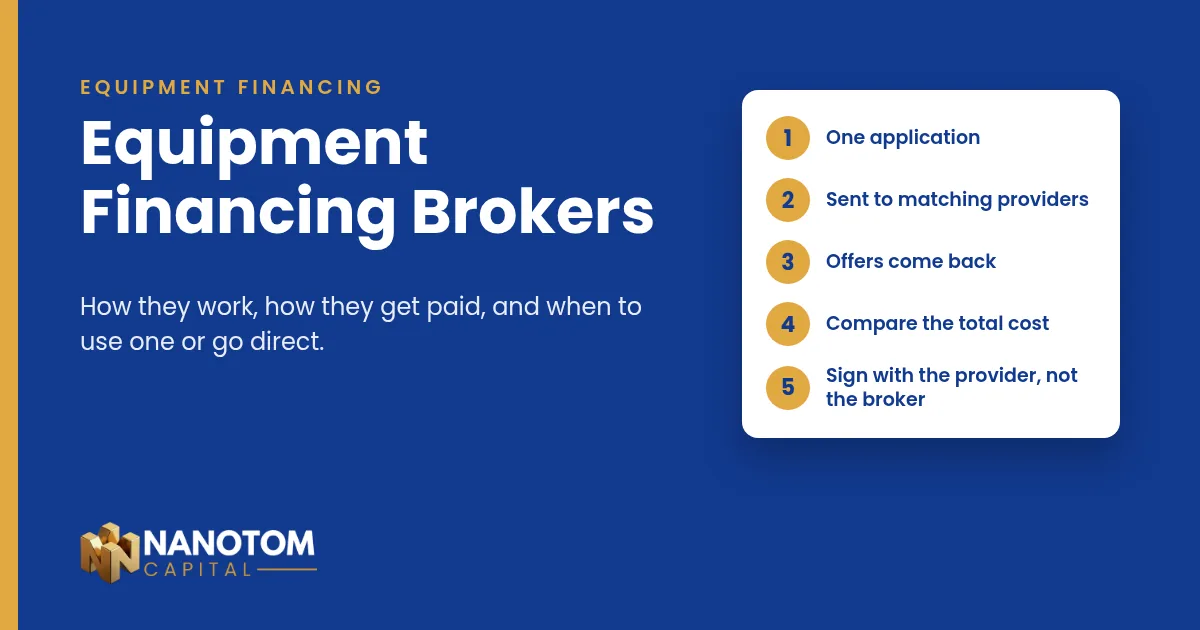
An equipment financing broker is a middleman who takes one application from your business to several lenders or leasing companies, helps you compare the offers that come back, and is paid when a deal funds. The broker doesn't lend its own money; the provider named in your agreement does.
That setup can save you weeks of shopping, but someone in the middle is being paid, and you should know how. We work as a broker ourselves, so this guide covers what we think every owner should ask any broker, us included: how brokers work, how they get paid, when one is worth using and when to go direct.
What is an equipment financing broker?
An equipment financing broker connects businesses that need machinery, vehicles or technology with the companies that finance them. You fill out one application, the broker sends it to providers whose rules fit your file, and you choose among the offers. Your contract is with the provider, and your payments go to the provider.
Don't confuse this with an equipment broker, who buys and sells used machinery. Some firms do both, but they are different jobs, and a dealer who arranges financing on the machine it sells you is something else again (see the table below).
If you are new to the subject, start with what equipment financing is and who offers it; our complete guide to equipment financing explains loans, leases and how to qualify, and our equipment financing options page shows how it works with us.
How does an equipment financing broker work?
Most broker deals follow the same seven steps, whatever the equipment.
Intake. You share your business details, the equipment and the seller's quote, usually through one application.
Matching. The broker picks providers whose rules fit your file: credit, time in business, revenue, equipment type and deal size.
Submission. Your application goes to those providers. Ask how many, and which ones.
Offers. Providers that approve send terms back through the broker.
Comparison. You review the payment, term, down payment, fees and total cost side by side.
Signing. You sign the provider's contract. Read it clause by clause; our guide to the clauses in an equipment financing agreement shows what to check.
Funding. The provider pays the seller, the equipment is delivered, and you start making payments to the provider.
The broker's job usually ends at funding. If a payment question or a dispute comes up later, you deal with the provider.
How do equipment financing brokers get paid?
Brokers are usually paid a commission by the provider, and some also charge you a fee. Neither is wrong in itself. A broker does real work, and a good one can find terms you wouldn't have found alone. The problem is not knowing, because the broker's pay can sit inside the rate or the payment you are offered.
So ask, in writing, who pays the broker on this deal and whether you pay any fee. Some states require the lender to show you a cost disclosure before you sign, and requirements vary by state, but asking costs nothing anywhere.
The bigger protection is comparing offers on the total you will repay. Here is why a small difference in rate matters. Example: the same $60,000 machine, financed over 60 months, at two different rates. These figures are an illustration, not an offer or Nanotom's rates; your rate and terms depend on the lender.
| Offer A: 9% APR | Offer B: 11% APR | |
|---|---|---|
| Monthly payment | about $1,246 | about $1,305 |
| Total of 60 payments | about $74,730 | about $78,273 |
| Cost of the money | about $14,730 | about $18,273 |
A gap of about $59 a month becomes about $3,543 over the term. Run your own offers through our equipment financing calculator before you choose, and add any fees due at signing to the total.
Broker vs. direct lender vs. dealer financing
There are three common routes to the same machine. Each puts a different company between you and the money.
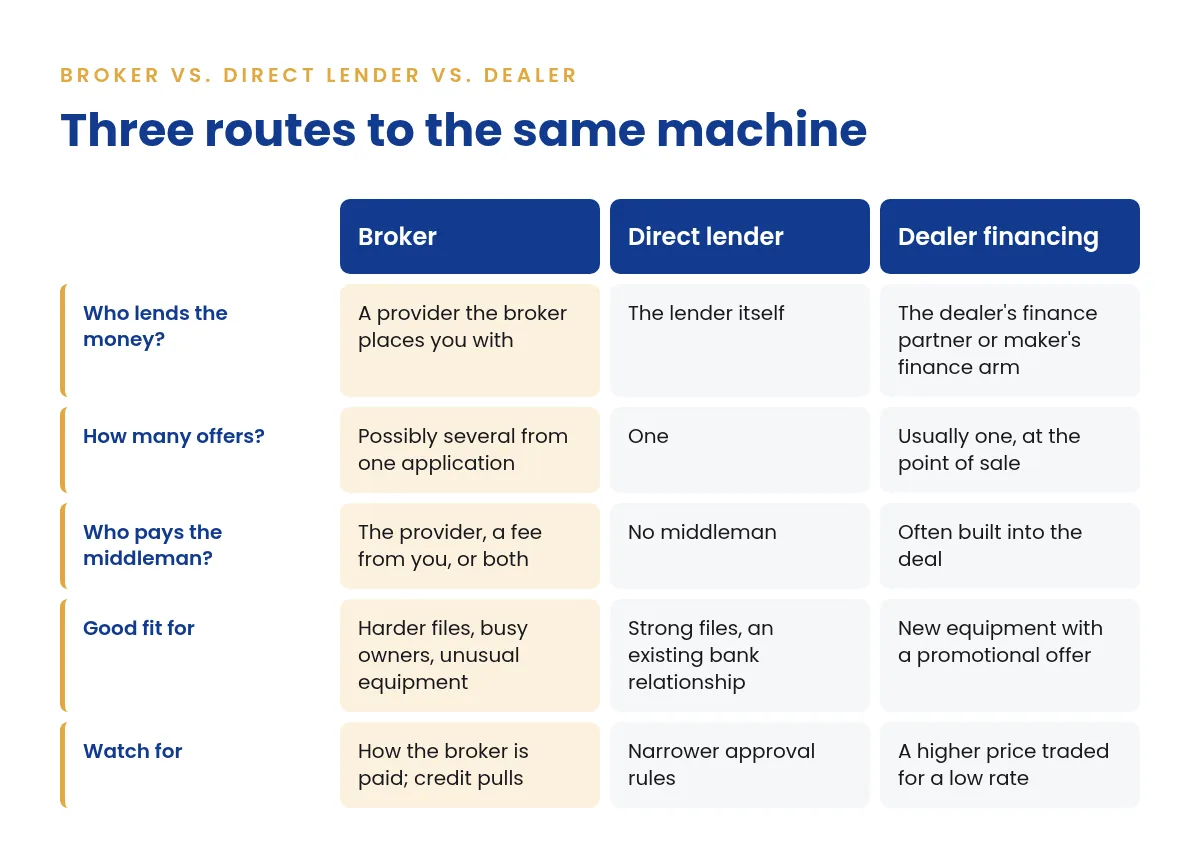
| Broker | Direct lender | Dealer or manufacturer financing | |
|---|---|---|---|
| Who lends the money? | A third-party provider the broker places you with | The lender itself | The dealer's finance partner or the maker's finance arm |
| How many offers do you see? | Possibly several from one application | One | Usually one, at the point of sale |
| Who pays the middleman? | The provider, a fee from you, or both | No middleman | Often built into the deal |
| Who is it a good fit for? | Harder files, busy owners, unusual equipment | Strong files and an existing bank relationship | New equipment with a promotional offer |
| What should you watch for? | How the broker is paid; how many credit pulls | Narrower approval rules | A higher equipment price traded for a low rate |
If you would rather shop providers yourself, our roundup of equipment financing companies is a place to start.
Pros and cons of using an equipment financing broker
Pros
One application can reach several providers.
A good broker knows which providers accept which files, which can save you declined applications.
Useful for used, specialized or unusual equipment that mainstream lenders avoid.
Someone to explain the offers in plain English before you commit.
Cons
The broker's pay may raise your cost.
Quality varies widely from broker to broker.
You see only the providers that broker works with, not the whole market.
More hands on your application means more questions to ask about credit pulls.
When a broker makes sense, and when to go direct
A broker usually makes sense when:
You have been declined, have thin or damaged credit, or run a newer business.
The equipment is used, specialized or unusual.
You don't have time to apply to several providers and compare them yourself.
The data backs up shopping around. In the Federal Reserve's 2025 Small Business Credit Survey, only 42% of employer firms that applied for financing received the full amount they sought, and 60% of firms that borrowed from online lenders said the actual cost was higher than they expected (2026 Report on Employer Firms).
Going direct often makes more sense when:
Your credit and financials are strong, and your bank already knows you.
The dealer offers promotional financing on new equipment and you have checked the cash price.
The deal is simple and you are comfortable comparing offers on your own.
If that describes you, you may not need a broker at all, including us. Use the questions below on any lender and compare the totals.
How to vet an equipment financing broker
8 questions to ask before you apply
Are you a lender, a broker, or both?
Which providers will see my application, and how many?
How are you paid on this deal, and by whom? Will you put that in writing?
Do I pay any fee, and when?
Will applying trigger a hard credit pull? How many, and at what stage?
Will the provider be named before I sign?
Are you licensed or registered where my state requires it?
Can I read the full agreement, not a summary, before signing?
Red flags
The Consumer Financial Protection Bureau's list of classic warning signs of fraud applies to financing offers too. It says: "Never pay up front for a prize or offer." Walk away from a broker who:
Asks for a fee before you are approved, whatever it is called.
Promises approval before anyone has reviewed your credit or your business.
Pushes you to sign today. The CFPB says to walk away if you don't have time to read the details or ask questions.
Asks for payment by wire, gift card or payment app, or for access to your bank login.
Won't name the provider, or hands you an agreement with blanks in it.
Licensing and disclosure
Rules for brokers and lenders vary by state. Some states license commercial loan brokers, and some require the lender to show you a cost disclosure before you sign. Ask the broker which licenses or registrations it holds, and check with your state's financial regulator or state consumer protection office if you are unsure.
Does using a broker hurt your credit?
It depends on how your application is handled, not on whether a broker is involved. According to the CFPB, soft inquiries "will not affect your credit scores," while hard inquiries made when you apply for credit can, because scoring models look at how recently and how often you apply.
Many providers run a hard pull before final approval. So ask how many providers will pull your credit and at what stage. A careful broker sends your file only where it has a real chance, rather than to every provider at once.
Nanotom Capital is a business funding broker; we're not the lender.
Frequently asked questions
What does an equipment financing broker do?
A broker takes your application to lenders or leasing companies, helps you compare their offers and gets you to signing. The broker doesn't lend money; the provider named in your agreement does, and you make your payments to that provider.
Is it better to use a broker or a direct lender?
Neither is right for everyone. A broker helps when your file is harder to place or you want several offers from one application. A direct lender can be simpler when your credit is strong and you already know which lender you want.
How much does an equipment financing broker cost?
It varies by broker and deal. Brokers are usually paid a commission by the provider, and some also charge a fee. Ask for the amount in writing and compare offers on the total you will repay.
As Denis Brandao, Founder & CEO of Nanotom Capital, puts it: "Most owners take the first offer they get. A few minutes of comparing can save thousands."
Do equipment financing brokers charge upfront fees?
Some charge fees, but a fee demanded before you are approved is a warning sign. The CFPB's advice is never to pay up front for an offer. Any legitimate fee should be stated in writing, with when it is due.
Can a broker help me get equipment financing with bad credit?
A broker can't promise approval. What a good broker can do is send your file to providers whose rules fit it, which can improve your odds and cut down on declined applications. Requirements vary by lender.
Who do I make payments to if I use a broker?
You pay the provider named in your agreement, not the broker. The broker's role usually ends once the deal funds.