
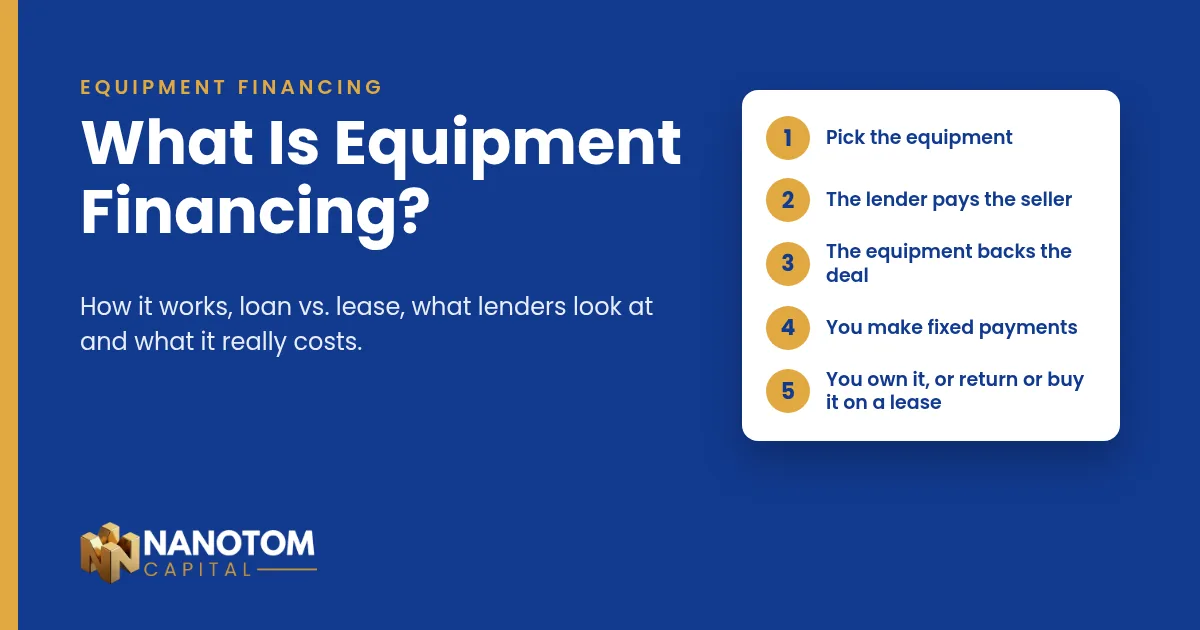
Equipment financing is a loan or lease that lets a business get the equipment it needs now and pay for it over time, with the equipment itself usually serving as collateral. Instead of one large payment up front, the cost arrives as a fixed series of monthly payments.
So what is equipment financing in practice? This plain-English guide explains how a deal works from quote to delivery, how a loan differs from a lease, what lenders look at, what lenders publish about credit scores and terms, and how to work out what an offer really costs. It also covers when equipment financing is the wrong choice.
What is equipment financing?
Equipment financing is money used for one purpose: buying or leasing a specific piece of business equipment. The lender pays the seller, you make payments over a set term, and the lender holds a claim on the equipment until you have paid. Because the equipment backs the deal, you usually don't have to pledge other business assets.
It comes in two main forms. With an equipment loan (or an equipment financing agreement), you own the equipment and pay it off. With an equipment lease, the leasing company owns it and you pay to use it for the term.
It covers almost anything a business runs on: ovens, trucks, excavators, X-ray machines, servers. It doesn't cover real estate; buildings and land need a commercial mortgage. For the full process of getting a loan, see our complete guide to equipment financing, or compare the equipment financing options we work with.
How does equipment financing work?
Most deals follow the same seven steps, whichever lender you use.
- Pick the equipment. Get a written quote from the seller, including delivery, installation and training.
- Apply. Share basic details about the business, its revenue and the equipment.
- The lender reviews. It looks at your credit, your business and the equipment's value and resale market.
- You get an offer. It states the payment, the number of payments, any down payment and the fees.
- You sign the agreement. The lender usually files a public UCC-1 notice that records its claim on the equipment.
- The lender pays the seller. You take delivery and put the equipment to work.
- You make fixed payments. On a loan, the lender releases its claim once you have paid in full.
The order matters for cash flow: the equipment can start earning before most of it is paid for.
Equipment loan vs. equipment lease
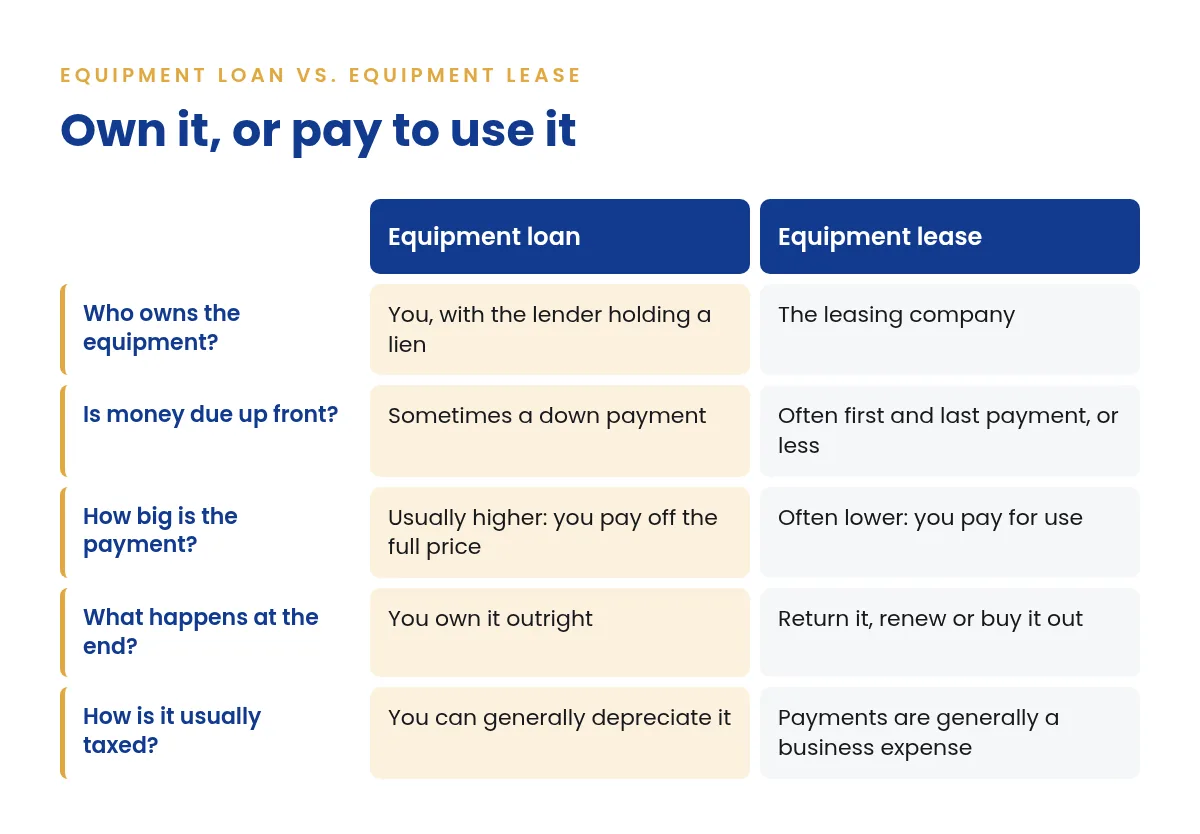
The main choice inside equipment financing is whether to own the equipment or rent it for the term.
| Equipment loan | Equipment lease | |
|---|---|---|
| Who owns the equipment? | You, with the lender holding a lien | The leasing company |
| Is money due up front? | Sometimes a down payment | Often first and last payment, or less |
| How big is the payment? | Usually higher: you pay off the full price | Often lower: you pay for use |
| What happens at the end? | You own it outright | Return it, renew or buy it out |
| How is it usually taxed? | You can generally depreciate it | Payments are generally a business expense |
A loan suits equipment you will use for many years. A lease suits equipment that goes out of date quickly, like computers or some medical systems. Our equipment leasing vs. financing guide walks through the trade-offs in detail.
A few terms you will see in offers:
- Equipment financing agreement (EFA): you own the equipment and pay a fixed stream of payments. It reads like a lease but works like a loan.
- Fair market value (FMV) lease: you can buy the equipment at the end for what it is worth then. Payments are usually lower.
- $1 buyout lease: you buy the equipment for $1 at the end, so it works much like a loan.
- UCC-1 filing: the public notice of the lender's claim on the equipment until it is paid off.
What can you finance with equipment financing?
Most physical equipment with a resale value can be financed, new or used:
- Restaurant and commercial kitchen equipment
- Construction and heavy machinery
- Trucks, trailers and commercial vehicles
- Medical and dental equipment
- Manufacturing and fabrication machines
- Farm equipment
- Computers, servers and office technology
- Salon, gym and laundromat equipment
Used equipment is common, though some lenders set an age limit or ask for more money down. Soft costs such as delivery, installation and software can sometimes be included; ask before you sign.
What do lenders look at?
Each lender sets its own rules, and requirements vary by lender. Most weigh the same five things.
Credit score
There is no single minimum credit score for equipment financing. For a sense of the market: one equipment lender's published minimums include a credit score of 640 or more, two years in business and $100,000 in annual revenue (see the table below).
On the standard 300 to 850 scale, scores from 580 to 669 count as "fair", and the score's maker says many lenders will approve loans with a score in that range (myFICO).
Lower scores can still work, usually with more money down or a shorter term. As Denis Brandao, Founder & CEO of Nanotom Capital, puts it: "Your credit score is only part of the story. Revenue and time in business matter just as much."
Time in business and revenue
Many lenders want to see a track record, often measured in years, plus bank statements that show the business can carry the payment. Newer businesses can qualify, but they may face a larger down payment, a shorter term or a closer look at the owner's personal credit.
The equipment itself
The lender is lending against the equipment, so its type, age and resale market matter. A truck with a deep used market is easier to finance than a custom machine only you can use.
Existing debt and a personal guarantee
Lenders check what the business already owes. Many also ask the owner to sign a personal guarantee. In the Federal Reserve's 2025 Small Business Credit Survey, 59% of firms with debt had used a personal guarantee to get it (Federal Reserve Banks, 2026 Report on Employer Firms).
How long are equipment financing terms?
Terms are usually set to match how long the equipment stays useful, and published ranges often run up to seven years. The figures below are examples from each lender's own page, read on 2026-10-27, not typical or current terms for any offer, and requirements vary by lender.
| What the lender publishes | Figure | Source |
|---|---|---|
| Minimum requirements for equipment financing | Credit score of 640 or more, 2+ years in business, $100,000+ annual revenue | Balboa Capital |
| Equipment financing loan terms | Up to 7 years, loans from $250,000 | Bank of America |
| Equipment financing term range | 24 to 84 months, with options for longer terms | Dogwood State Bank |
The point is the fit, not the longest term on offer. Paying for a laptop over seven years makes little sense; paying for a bulldozer over two may squeeze your cash flow. A longer term lowers the payment but usually raises the total you repay.
What does equipment financing cost?
Equipment loans are priced with an interest rate, shown as an APR. The rate you are offered depends on your credit, your time in business, the equipment, the term and the lender, so a quoted rate alone tells you little.
The clearest comparison is the total you will repay: the payment times the number of payments, plus fees, minus the equipment price.
Example: a $50,000 equipment loan at 10% APR over 60 months is about $1,062 a month, or about $63,741 in total, so the financing costs about $13,741.
This is an example, not an offer or Nanotom's rate; your rate and terms depend on the lender. To try other prices, rates and terms, use our equipment payment calculator or read our equipment financing calculator guide.
Check the total before you sign. In the same survey, 60% of online-lender borrowers said their actual costs were higher than they expected.
Benefits and downsides of equipment financing
Benefits
- Keeps cash free for payroll, inventory and surprises.
- The equipment backs the deal, so other assets usually stay unpledged.
- Fixed payments make budgeting easier.
- Possible tax savings. If you own the equipment, Section 179 may let you deduct its cost in the year it is placed in service. For tax years beginning in 2026, the limit is $2,560,000, reduced once qualifying purchases pass $4,090,000 (IRS Publication 946). Ask your CPA how it applies to you.
Downsides
- You pay more than the sticker price, because financing has a cost.
- The equipment can lose value faster than you pay it down, so you can owe more than it is worth.
- Payments are usually non-cancelable, even if the equipment breaks or sits idle.
- Default can mean repossession and, with a personal guarantee, personal liability.
How to apply for equipment financing
- Get the quote. Include delivery, installation and training.
- Check your credit. Know your personal and business scores before you apply.
- Gather documents. Lenders commonly ask for recent bank statements, your business tax ID, ownership details and the equipment quote; larger requests may need tax returns or financial statements.
- Apply. Apply with one lender, or through a broker that can show you several options at once.
- Compare offers on the total. Line up the payment, term, down payment, fees and total of payments.
- Read the agreement. Check ownership, the lien, any personal guarantee and what happens if you pay early. Our guide to the clauses in an equipment financing agreement covers each one.
- Take delivery. The lender pays the seller and your payments begin.
When equipment financing is the wrong fit
Equipment financing works when the equipment earns or saves more than it costs, for longer than the term. It is probably the wrong move when:
- The equipment will be out of date before it is paid off (a lease may fit better).
- You need it for one short job (renting may cost less).
- Your cash flow can't comfortably carry another fixed payment.
- You have the cash, and the financing cost outweighs the value of keeping it.
If you can pay cash without straining the business, you may not need financing at all, and that is fine.
Nanotom Capital is a business funding broker; we're not the lender.
Frequently asked questions
Is equipment financing a loan?
Usually, yes. Most equipment financing is a loan or an equipment financing agreement, where you own the equipment and pay it off. An equipment lease is the other form: the leasing company owns the equipment and you pay to use it.
What credit score do you need for equipment financing?
There is no single minimum; requirements vary by lender. One equipment lender in the table above lists a minimum of 640, and scores from 580 to 669 count as fair. Revenue, time in business and the equipment's value matter too.
How long can you finance equipment?
Published terms often run from about two years up to seven years, depending on the lender and the equipment. The term should match how long the equipment stays useful.
Is it better to finance or pay cash for equipment?
It depends on your cash. Paying cash avoids the financing cost. Financing keeps cash free for other needs, which can be worth more if the equipment earns more than it costs to finance.
Can a startup get equipment financing?
Yes, though options are narrower. Expect a closer look at the owner's personal credit, and possibly a down payment, a shorter term or a personal guarantee.
Can you finance used equipment?
Yes. Many lenders finance used equipment, though some set age limits or ask for more money down.