
An equipment financing agreement (EFA) is a contract where a lender pays for equipment, your business owns it from day one, and the lender keeps a security interest in it until the last payment clears. The cost usually arrives as a fixed stream of payments, not a stated interest rate.
The structure is simple; the fine print is not. We read three real agreements, two filed with the SEC and one lender's standard form, and they handle prepayment, late fees, and default in three different ways. Below are the 10 clauses that decide what an EFA actually costs you, with the language lenders use.
What is an equipment financing agreement?
An equipment financing agreement is a loan-style contract for buying business equipment. You hold title from the start, the equipment is the collateral, and the lender files a lien on it. Payments are fixed, and many EFAs state no interest rate or principal and interest split, because the finance charge is built into each payment.
That last point comes straight from a lender. One bank's blog describes the two biggest differences from a simple interest loan as no stated rate and no principal and interest breakdown. You owe the gross contract amount: every payment, added together.
Because you own the equipment, maintenance, insurance and liability sit with you, not the lender.
An EFA is one of several ways to pay for equipment. Our complete guide to equipment financing covers the other options and how to qualify, and our equipment financing options page shows how it works with us.
Equipment financing agreement vs. loan vs. lease
An EFA sits between a loan and a lease. It reads like a loan, with a lender and a borrower, but it is often sold with a lease's speed and fixed payments. The table shows where the three split.
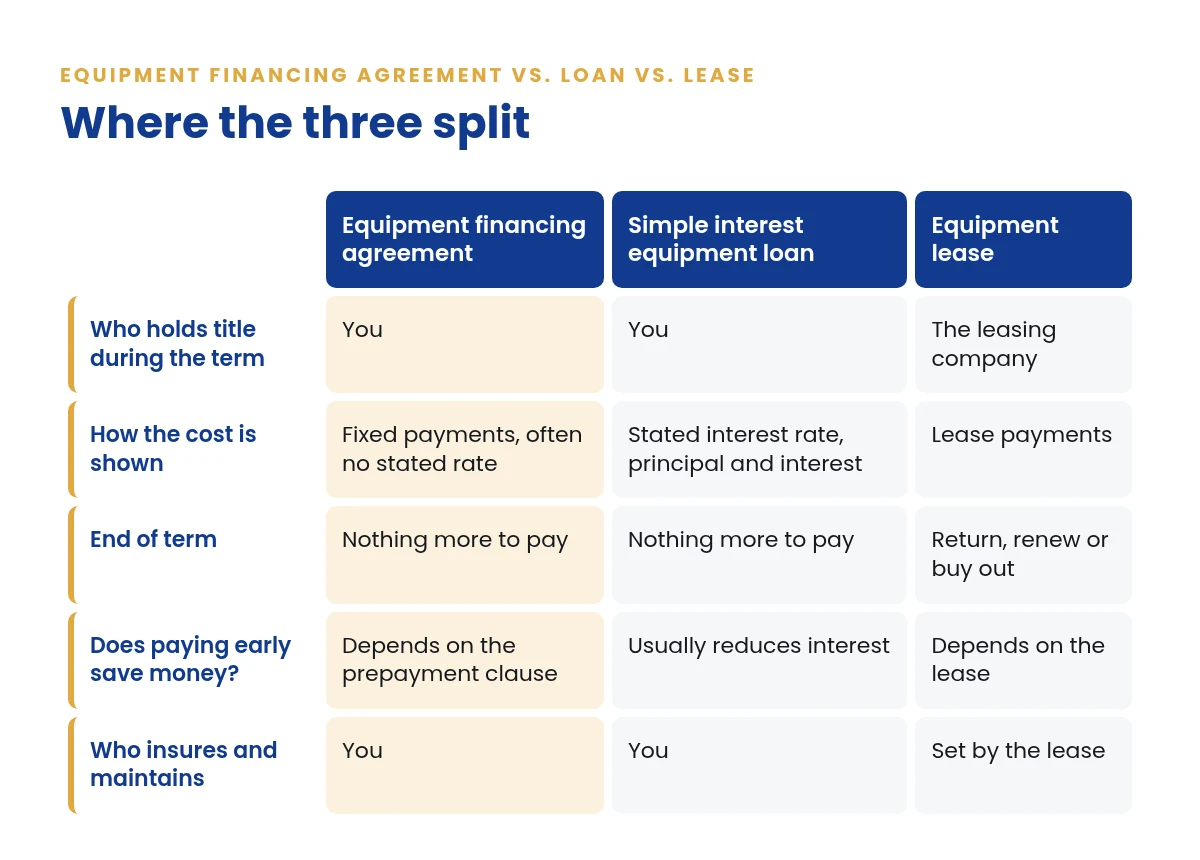
Equipment financing agreement | Simple interest equipment loan | Equipment lease | |
|---|---|---|---|
Who holds title during the term | You | You | The leasing company |
How the cost is shown | Fixed payments, often no stated rate | Stated interest rate, principal and interest | Lease payments |
End of term | Nothing more to pay | Nothing more to pay | Return, renew or buy out |
Does paying early save money? | Depends on the prepayment clause | Usually reduces interest | Depends on the lease |
Who insures and maintains | You | You | Set by the lease |
If you are still deciding between owning and leasing, our equipment leasing vs. financing guide covers lease types, buyouts and tax treatment in depth.
The 10 clauses to check in an equipment financing agreement
Every lender writes its own form, so clause numbers and titles move around. The substance does not. Find these 10 before you sign.
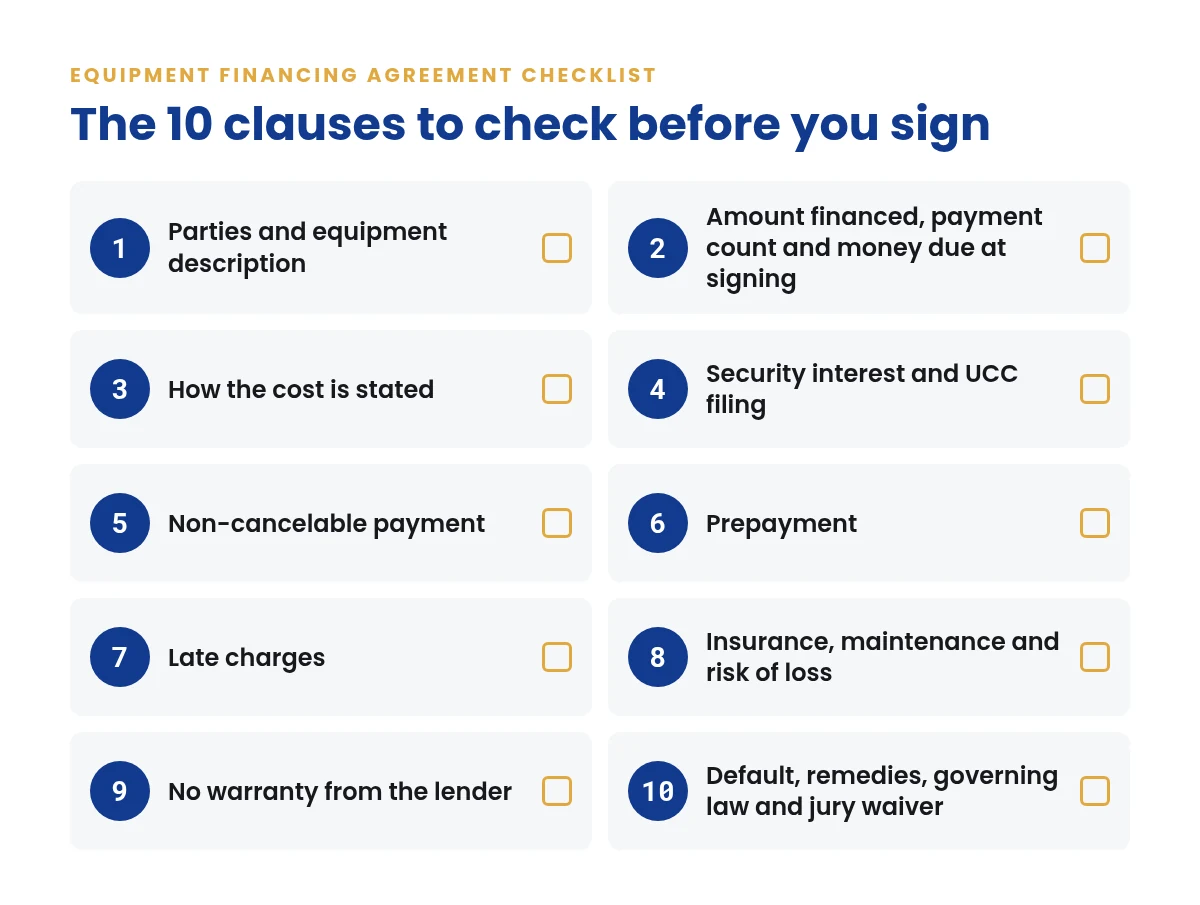
1. Parties and equipment description
The agreement should name your exact legal entity and list each item by model and serial number. A bank's 2012 agreement filed with the SEC asks for the "FULL DESCRIPTION OF COLLATERAL INCLUDING MODEL, SERIAL NUMBER." Errors here can make the lien attach to the wrong thing or the wrong borrower.
2. Amount financed, payment count and money due at signing
Look for the total amount, the number of payments, each payment amount, and anything due at signing: advance payments, a security deposit, fees. As an example, the same filing lists 120 monthly payments and a $500 fee.
3. How the cost is stated
If there is no rate, multiply the payment by the number of payments and subtract the equipment price. That difference is your finance charge. Run the numbers through our equipment financing calculator to compare offers on equal terms.
4. Security interest and UCC filing
The lender will take a security interest in the equipment and file a UCC financing statement. Read the definition of what the collateral secures. In the 2012 agreement, "Obligations" covers "any and all loans" you owe that lender, so the equipment can secure more than this one deal.
5. Non-cancelable payment
All three agreements we read make payment non-cancelable. Trinity Capital's 2021 master agreement calls each schedule "non-cancelable" and the payment duty "absolute and unconditional." If the machine breaks, you still pay, and you take it up with the seller.
6. Prepayment
This is where the three agreements differ most, so it gets its own table below. Ask one question: if I pay off early, how much do I save?
7. Late charges
Find the grace period and the fee. The 2012 agreement and one lender's published EFA form give 10 days after the due date before a late charge applies; the 2021 master agreement gives 5.
8. Insurance, maintenance and risk of loss
As owner, you carry the risk. The 2012 agreement says the borrower "bears the entire risk of loss" and must keep all-risk insurance. Budget the premium before you compare monthly payments.
9. No warranty from the lender
The lender did not sell you the equipment and will not stand behind it. The 2012 agreement states: "THIS AGREEMENT IS SOLELY A FINANCING AGREEMENT." The 2021 master agreement says you accept the equipment "as is, where is." Warranty claims go to the manufacturer or dealer.
10. Default, remedies, governing law and jury waiver
Read what counts as default and what happens next. Under UCC § 9-609, a secured lender can take the collateral after default without going to court, if it does so without a breach of the peace.
Also check which state's law applies, where disputes are heard, and whether you waive a jury trial. The 2012 agreement and the published EFA form both include a jury waiver.
What real agreements and one lender say about prepayment and late fees
Prepayment is the clause borrowers skip and regret. Here is what the documents actually say. The fees below are examples from the cited agreements, not typical or current terms; every lender sets its own.
Source | Paying off early | Late charge |
|---|---|---|
First Niagara Leasing EFA, filed with the SEC in 2012 | No prepayment or cancellation in the first 12 months. After that, a premium of 5% of the outstanding balance plus unamortized origination costs | 5% of the amount due or $20, whichever is greater, if unpaid 10 days after the due date |
Allowed in full by paying "the entire outstanding balance of all payments due" | $15, or interest at the lesser of 18% a year or the highest legal rate, if unpaid 10 days after the due date | |
Pay off any time without a penalty, but early payments "do not reduce the amount of finance charges owed" | Not stated |
Read the wording in the last two rows closely. "No penalty" and "pay the remaining payments" can mean the same thing: you owe the full finance charge whether you pay in month 6 or month 60. If an early payoff matters to you, ask for the payoff figure in writing before you sign.
How to read an equipment financing agreement before you sign
Get the total of payments. Payment amount times number of payments, plus anything due at signing.
Compare it to the equipment quote. The gap is the true cost of the money.
Find the prepayment clause and ask for a written payoff example.
Read the collateral definition to see whether it reaches beyond this equipment.
Check the late charge and grace period.
Confirm insurance requirements and price the policy.
Note governing law, venue, and any jury waiver, and have your attorney or CPA review anything you do not understand.
When an equipment financing agreement is the wrong fit
An EFA is built for equipment you plan to keep. If you replace technology on a short cycle, a lease that lets you return it may cost less in practice. If you expect to pay off early, an EFA whose prepayment clause keeps the full finance charge works against you; a simple interest loan may suit you better.
And if you already hold a lender's agreement you are happy with, you do not need us. Use the checklist above and sign with confidence.
Nanotom Capital is a business funding broker; we're not the lender.
Frequently asked questions
Is an equipment finance agreement a lease?
No: in an EFA, you own the equipment from the start and the lender holds a security interest. In a lease, the leasing company keeps title and you pay to use it. Some EFAs borrow a lease's fixed payments and fast paperwork, which is why the two get confused.
What are typical terms for equipment financing?
There is no standard term. A bank's 2012 agreement filed with the SEC ran 120 monthly payments; one lender's published EFA form leaves the number of months blank for each deal. Ask for a term that matches how long the equipment will keep earning, and compare total cost, not monthly payment.
How hard is it to get equipment financing?
It depends on your credit, time in business, revenue and the equipment itself. Because the equipment is the collateral, the asset carries part of the decision. Requirements vary by lender.
How do you compare equipment financing offers?
Compare the total of payments and the terms you can live with, which you only know after reading each agreement. Price, prepayment rules and collateral reach vary by lender. As Denis Brandao, Founder & CEO of Nanotom Capital, puts it: "Fast money is great until it costs you twice. Know your total cost of capital before you commit." Our roundup helps you compare equipment financing companies side by side.
Can you pay off an equipment financing agreement early?
Usually, but saving money is a separate question. Some agreements block prepayment for a period or charge a premium, and others let you pay off only by paying every remaining payment. Read the prepayment clause and get a written payoff figure.
Do I get tax benefits from an equipment financing agreement?
Because you own the equipment, it may qualify for depreciation or the Section 179 deduction. For tax years beginning in 2026, IRS Publication 946 sets the maximum Section 179 deduction at $2,560,000, reduced once qualifying purchases pass $4,090,000. Confirm your situation with a tax advisor.